Rafeeq Daha • June 16, 2026
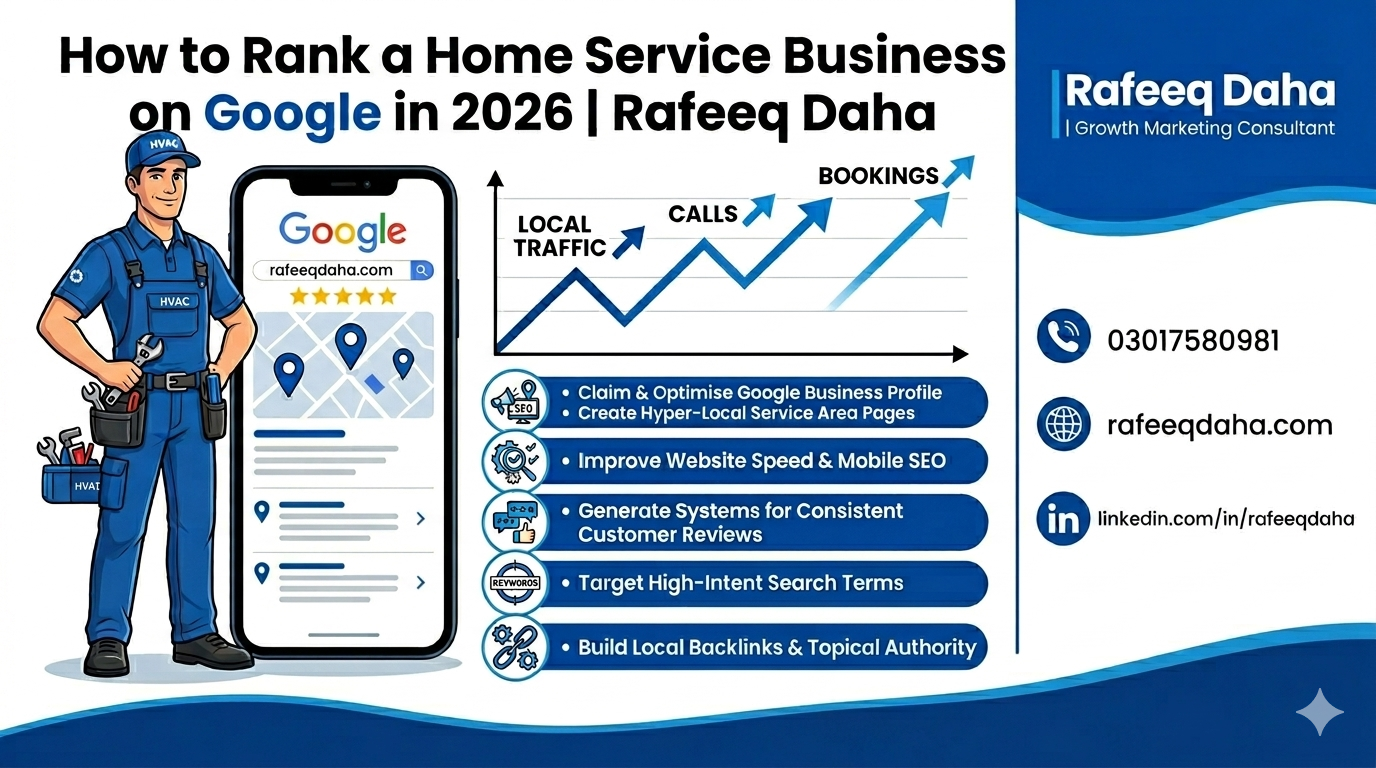
How to Rank a Home Service Business on Google in 2026
When a homeowner's furnace stops working at 11 pm in January, they are not scrolling through their contacts looking for a recommendation. They pick up their phone, type 'HVAC repair near me', and call whoever shows up first.
That is the entire game for home service businesses on Google. First page, ideally top three results, ideally in the Maps pack. Everything else — your referral network, your truck wraps, your yard signs — is secondary to whether you exist in that search result at the moment someone needs you.
The good news is that local SEO for home service businesses is more achievable than most people think. You are not competing against Amazon or national media outlets. You are competing against other local contractors, most of whom have made no real investment in SEO at all. The bar to clear in most local service markets is genuinely low.
This guide covers exactly what you need to do to rank your HVAC, roofing, plumbing, or home service company on Google in 2025 — in the order you should do it, with no fluff.
Step 1 — Claim and Fully Optimise Your Google Business Profile
If you do nothing else on this list, do this. Your Google Business Profile (formerly Google My Business) is the single most powerful local SEO asset available to a home service business. It directly controls whether you appear in the Google Maps results — the three listings that appear with a map at the top of local search results — which capture a disproportionate share of clicks and calls.
A large number of home service businesses have a Google Business Profile that was either auto-generated by Google or set up years ago and never touched since. These profiles are incomplete, which suppresses their ranking. Here is what a fully optimised profile looks like:
- Business name exactly matches what is on your website and other directories — no keyword stuffing in the name field
- Primary category is correct and specific: 'HVAC Contractor', 'Plumber', 'Roofing Contractor' — not just 'Contractor'
- All relevant secondary categories added — most businesses only set one
- Service areas listed explicitly — every city, suburb, and county you serve
- All services listed under the Services tab with descriptions
- At least 10 photos uploaded — exterior of truck, team on job, completed work, office if applicable
- Q&A section seeded with your most common questions and answers
- Google Posts published at least once per week — job completions, seasonal offers, service highlights
The most important action after completing your profile is generating more reviews. Google's local ranking algorithm weights review count, review rating, and review recency heavily. A business with 80 reviews and a 4.8 average will outrank a business with 20 reviews and a 5.0 average in most markets.
How to get more Google reviews systematically
The highest-converting method is a text message sent automatically within 24 hours of job completion — directly to the homeowner's cell phone with a link to your Google review page. Most satisfied customers are happy to leave a review when it takes less than one minute. The key is making the link direct: it should open Google Maps with your review form pre-loaded, not take them to a page where they have to search.
Step 2 — Fix Your NAP Consistency Across the Web
NAP stands for Name, Address, and Phone number. Google uses your NAP information across dozens of online directories — Yelp, Angi, HomeAdvisor, BBB, Yellow Pages, and many others — to verify that your business is legitimate and to understand your service area.
When your NAP information is inconsistent across these directories — your phone number has a different area code on one site, or your address is listed as 'St' in some places and 'Street' in others — Google's confidence in your business information decreases. This suppresses your local rankings.
How to audit and fix NAP consistency
Run a free scan at BrightLocal.com or Moz Local. Both tools show you every directory where your business is listed and flag any inconsistencies. Fix every mismatch you find, starting with the highest-authority directories: Google, Yelp, Facebook, and BBB.
For directories where you have no listing at all, create them. The major ones that matter most for home service businesses are Angi, HomeAdvisor, Houzz, Thumbtack, and the Better Business Bureau. Each listing with consistent NAP information is a trust signal to Google.
Step 3 — Build Dedicated Service Area Pages on Your Website
Most home service websites have one page that says something like 'We serve the greater Dallas metropolitan area.' That single page cannot rank for searches that include specific city names — which is how most homeowners search.
A homeowner in Plano, Texas searches 'plumber Plano TX', not 'plumber Dallas metropolitan area.' A homeowner in Naperville, Illinois searches 'HVAC company Naperville', not 'HVAC Chicagoland.' If you do not have a dedicated page targeting each of these specific locations, you will not rank for those searches regardless of how good your main website is.
What a service area page needs to contain
- The city name and your primary service in the H1 heading and URL slug
- A genuine description of your work in that area — not just the city name swapped into a template
- Your Google Business Profile is embedded or linked for that location
- Reviews specifically from customers in that city, if available
- A clear CTA with a phone number and booking link
For a business serving 10-15 cities, this means building 10-15 dedicated pages. It is a significant investment of time but it directly produces rankings for buyer-intent local searches that a single homepage cannot capture.
Step 4 — Target the Right Keywords on Your Main Website Pages
Most home service websites are optimised for their company name. Which is useful if someone already knows you exist — but worthless for capturing new customers who are searching for what you do, not who you are.
The keywords that generate revenue for home service businesses follow a predictable pattern:
Emergency and immediate-need searches
These are the highest-converting searches because the intent is clear and urgent. 'Emergency plumber near me', 'AC repair same day [city]', 'roof leak repair emergency'. These searches happen at the moment of a problem and convert at extremely high rates. Your homepage and your Google Ads should be specifically optimised for these.
Service-specific searches
'Water heater replacement [city]', 'HVAC installation near me', 'roof replacement cost [city]'. These are slightly lower urgency but very high commercial intent — the person is actively evaluating their options. Dedicated service pages targeting each of these search types perform significantly better than a single services overview page.
Research-phase searches
'How much does roof replacement cost', 'HVAC maintenance checklist', 'signs you need a new water heater'. These searches come from homeowners earlier in their buying journey. Blog posts targeting these searches build authority and capture email addresses through lead magnets, creating a nurture path to eventual booking.
The practical application: your main website pages should be optimised for emergency and service-specific keywords. Your blog should target research-phase searches. Both types of content serve a different stage of the buyer journey and together build a comprehensive SEO presence.
Step 5 — Build Backlinks Through Local Partnerships and PR
A backlink is a link from another website to yours. Google treats backlinks as votes of confidence — the more credible websites that link to you, the more Google trusts your site and the higher it ranks.
For local home service businesses, the most effective backlink sources are not complex PR campaigns. They are straightforward local relationships:
- Your local Chamber of Commerce — most chambers list member businesses on their website with a link
- Local business associations — home builders associations, contractors associations, trade groups
- Supplier and manufacturer partner directories — if you are a certified Carrier HVAC dealer or a CertainTeed roofing installer, those manufacturer websites often have dealer directories with links
- Local news coverage — a press release about a community project, a charity partnership, or a significant company milestone can generate local news coverage with backlinks
- Sponsorships — local sports teams, community events, school fundraisers — sponsorships often come with a website listing
You do not need hundreds of backlinks to rank in a local market. In most mid-sized US cities, 15-20 quality local backlinks is sufficient to significantly improve your local rankings. Start with the easiest ones — Chamber of Commerce and supplier directories — and work outward.
Step 6 — Publish Consistent Content That Builds Topical Authority
Google's algorithm rewards websites that consistently publish useful, relevant content in a specific topic area. A website that publishes four helpful articles about HVAC maintenance, seasonal tips, and common HVAC problems every month for a year will outrank a website that published one article about HVAC three years ago — even if that one article was excellent.
Consistency matters more than volume. One post per week published reliably is better than eight posts in January and nothing for the rest of the year.
For home service businesses, the content that works best is genuinely practical: how to tell if your water heater is about to fail, what to do when your AC stops working before you call a technician, how to prepare your roof for winter. Content that a homeowner would bookmark and share is content that earns rankings.
Step 7 — Fix Your Website's Technical SEO
Technical SEO is the foundation that determines whether Google can properly crawl, index, and rank your website at all. You can have perfect content and a strong Google Business Profile and still rank poorly if your website has fundamental technical problems.
The most common technical SEO issues I find on home service websites:
- Pages loading in over 4 seconds on mobile — Google penalises slow sites and users abandon them
- No HTTPS secure connection — sites without SSL are flagged as 'not secure' in Chrome
- Duplicate content — the same content accessible at multiple URLs confuses Google about which page to rank
- Missing or duplicate meta titles and descriptions — every page needs unique, descriptive metadata
- No XML sitemap submitted to Google Search Console — Google may not even know all your pages exist
- Broken links — both internal links and external links that return 404 errors
How to audit your technical SEO
Install Google Search Console (it is free) and submit your sitemap. Search Console will flag indexing errors, mobile usability problems, and pages with missing metadata. Run your site through Screaming Frog SEO Spider (free up to 500 pages) for a comprehensive technical audit.
For most home service websites, fixing the top five issues identified by Search Console will produce a meaningful improvement in rankings within 60-90 days.
How Long Does It Take to See Results?
This is the question every home service business owner asks, and the honest answer is: it depends on your starting point.
If you currently have no Google Business Profile, no local citations, and a website with no SEO optimisation at all, you can expect to see meaningful movement in 3-5 months. Not dramatic results — meaningful movement. Ranking on page 2 instead of page 5, appearing in the Maps pack occasionally, getting calls from organic search that you were not getting before.
If you already have a solid Google Business Profile and a reasonable number of reviews, and you are making the changes in this guide — technical fixes, service area pages, consistent content — you will typically see results in 6-12 weeks in a mid-competitive market.
If you are in a highly competitive major metro market competing against large, well-funded companies, expect 6-12 months before organic search becomes a meaningful lead source.
This is why I always recommend running Google Ads in parallel with SEO — especially in the first 3-6 months. Ads provide immediate lead flow while organic rankings build over time. The goal is to have both working so you are not entirely dependent on either.
Where to Start
If you read this guide and already know you have several of these issues — a Google Business Profile that has not been touched in years, no service area pages, no consistent content — the fastest next step is an audit that tells you exactly which gaps are costing you the most leads.
Recent Posts